SKU: 20030153191
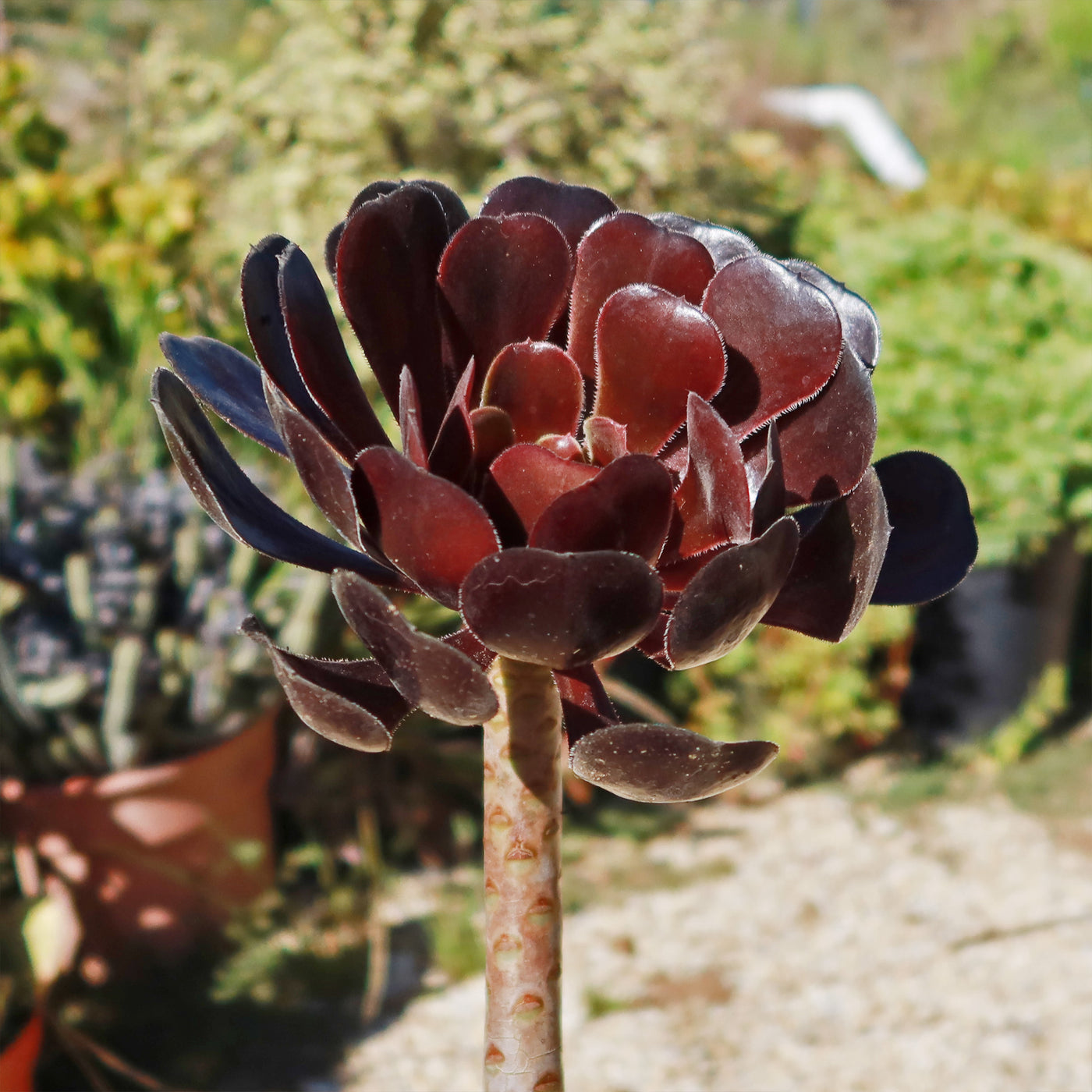
black and red succulent

black and red succulent Shop 'Black Rose Succulent - Aeonium Zwartkop' Care and Info

Sale price$23.52 Regular price$26.13
Save 10%

Pay in installments of $6.53 with ShopPay, AfterPay and Klarna

Shipping Estimate
USA
  • USA
  • CAN

Ships within 48 hours · Estimated delivery Jul 27 - Aug 1

Promo Codes Available:

For Your Every Summer RSVP, with Code: SUMMER15

Description

black and red succulent Shop 'Black Rose Succulent - Aeonium Zwartkop' Care and InfoIntroducing the black rose, known as Aeonium Zwartkop', a beautiful variety of Aeonium arboreum. The name "Black Rose" comes from its leaves, which have a deep purple black tint that resembles roses. It is not a rose, but a succulent plant from the Crassulaceae family. The black rose Aeonium zwartkop has several other common names, such as Aeonium arboreum zwartkop, Aeonium black rose, purple crest aeonium, Aeonium 'black beauty', or tree aeonium.

Introducing the black rose, known as Aeonium Zwartkop', a beautiful variety of Aeonium arboreum. The name "Black Rose" comes from its leaves, which have a deep purple-black tint that resembles roses. It is not a rose, but a succulent plant from the Crassulaceae family.

The black rose Aeonium zwartkop has several other common names, such as Aeonium arboreum zwartkop, Aeonium black rose, purple crest aeonium, Aeonium 'black beauty', or tree aeonium. 

Hailing from the Canary Islands and reaching 5 feet in height and 3 feet in diameter at maturity, the black rose aeonium forms clumps and is sure to make a statement wherever it's planted.

When grown in full sun, the foliage takes on a deep, almost black color, which is why it's often referred to as the "Black Rose."

When grown in partial shade, the rosettes display a beautiful combination of purple-red hues with a green center. It's such a versatile plant that can add a touch of elegance and drama to any garden or succulent collection.

The flowers of Aeonium zwartkop bloom in the spring and produce clusters of small, yellow, star-shaped flowers that emerge from the center of its rosette-shaped foliage. The contrast between the dark purple-black leaves and the bright yellow flowers creates a stunning display. The flowers attract bees and other pollinators, adding life and movement to your garden.

Being a winter-growing plant, the Aeonium arboreum enters a state of dormancy during the scorching hot summer; during this time, the older leaves simply curl towards their points of growth rather than falling off entirely, giving the appearance of a black rosebud that is about to bloom. It's like a little garden masterpiece!

When and How to Water Your Black Rose  

From fall through spring, during its active growing season, Aeonium 'Black Rose' should be watered every 7–10 days, only when the top 1-2 inches of soil is completely dry. This is when the plant is most active, producing new leaves and expanding its rosettes. If under-watered during the growing season, you may notice the stems shriveling and leaves slightly puckering, but they'll quickly bounce back once hydrated.

In the summer months, when the plant enters dormancy, watering is reduced drastically to every 2–4 weeks or less. Aeonium 'Black Rose' naturally slows its growth or temporarily halts it during hot summer weather, especially in warmer zones or indoor conditions.

The plant conserves moisture during this rest period, so watering too often can lead to leaf drop or root problems. Only water if the plant begins to look overly stressed or if the soil has been dry for a prolonged time, again, always check at least two inches deep before watering.

Light Requirements - Where to Place Your Black Rose Succulent 

When growing the black rose succulent indoors, it's important to provide it with bright, indirect light for at least 4-6 hours a day. Keeping it in a well-lit area will help maintain the deep coloration of its leaves and promote healthy growth.

When grown outdoors, the black rose aeonium thrives in full sun to partial shade. In full sun, the foliage of this succulent turns almost black, which is why it's often referred to as the "Black Rose."

The intense sunlight brings out the deepest coloration in its leaves, creating a striking visual contrast. However, if you prefer a different look, placing it in partial shade will result in rosettes that display purple-reddish hues with a green center.

Remember, if your Aeonium 'Zwartkop' is exposed to too much direct sunlight and is not used to it, then there is a chance that the leaves might get damaged. It's critical to remember that during a heatwave or periods of extreme heat, your black rose succulent can get sunburned. You can protect the plant in this situation by moving it indoors or to a shaded area.

Optimal Soil & Fertilizer Needs 

The Aeonium zwartkop prefers sandy, well-drained soil, as excess moisture can promote root and stem rot. Planting them in ordinary soil will result in compacted roots, stunted growth, and most likely root rot. Instead, make or buy a well-draining potting mix, or ideally use our specialized succulent potting mix that contains 5 natural substrates and mycorrhizae to promote the development of a strong root system that helps your Aeonium succulent to thrive.

A small amount (5-10-5) of NPK fertilizer once a year in the spring will do wonders for your plant's health and growth. Using a natural fertilizer ensures that other beneficial compounds and microbes are added to the soil without the use of harsh chemicals. Show your succulent some love with awesome natural fertilizer and watch it thrive.  

Optimal Indoor Temperature & Humidity 

Aeonium 'Black Rose' thrives indoors at temperatures between 65–75°F with low to moderate humidity levels around 30–50%.

Keep your Aeonium away from cold drafts, heating vents, and sudden temperature changes. Place it near a bright window with indirect light, and ensure the space remains dry and airy to mimic its native Mediterranean-like climate.

Hardiness Zones & More

In the United States, this is mostly an indoor plant, but if you live in southern Florida or Hawaii, then you can cultivate it outdoors in USDA zones 9-12.

They are not cold- or frost-tolerant, you should plant them indoors or put them in a pot.

Move them indoors during the winter if you live outside of these regions. 

As for humidity, this succulent is adaptable and can tolerate average indoor humidity levels. However, it's important to provide good air circulation to prevent any issues with excessive moisture or stagnant air.

Wildlife - Black Rose Succulent Attracts the Following Friendly Pollinators

The Black Rose Succulent is known to attract a variety of friendly pollinators such as bees, butterflies, and hummingbirds with its vibrant blooms and sweet nectar. These pollinators play a crucial role in the plant's reproduction process by transferring pollen from one flower to another, ultimately helping the succulent thrive and produce seeds.

Butterflies
Bees
Hummingbirds
Lady Bugs
Multi Pollinators
Other Birds

According to the ASPCA, the Black Rose Succulent is non-toxic to humans and pets. It is safe to touch and is a popular choice for indoor houseplants due to its unique appearance and low maintenance requirements.

How to Propagate Your Black Rose Succulent

To propagate the black rose aeonium, one common method is through stem cutting. Simply take a healthy stem from the mature plants, making sure it is at least a few inches long. Allow the cutting to dry for a few days to form a callus, which helps prevent rotting. Then, plant the cutting in well-draining soil and keep it lightly moist until roots develop. With minimal water and full sun exposure requirements, this perennial is perfect for those looking for a low-maintenance addition to their garden or indoor space.

Key Takeaways

  1. The Black Rose Succulentis famous for its dramatic, rosette-shaped foliage in deep burgundy to nearly black hues, making it a striking focal point in any garden or collection.
  2. In late winter to early spring, mature plants produce tall stalks with clusters of bright yellow, star-shaped flowers, creating a striking contrast against the dark foliage.
  3. Aeonium ‘Zwartkop’ is highly drought-tolerant, requiring minimal watering, making it an excellent choice for xeriscaping or low-maintenance gardening.
  4. This winter-growing perennial, enters dormancy during hot summers, with older leaves curling towards growth points, resembling a black rosebud about to bloom.

Final Thoughts

Overall, the Aeonium zwartkop (black rose) is a unique and elegant succulent that can be a great addition to any indoor or outdoor space. Its dark foliage adds elegance and can be easily cared for with bright, indirect light indoors or full sun to partial shade outdoors. Keep your black rose aeonium away from cold, drafty windows and air vents if you are growing them indoors in a cold climate. The plant's distinctive black foliage or vibrant purple-reddish hues make it a standout in any garden or indoor decor. Its rosette-shaped leaves and compact growth habit add visual interest and can be a conversation starter.  

Be sure to add the ‘Aeonium arboreum ‘Zwartkop’ (black rose succulent) to your collection today and elevate the beauty of your home or garden, with this stunning-looking plant. 

Shipping Notes
  • Free Standard Shipping on $100+ Orders to the USA.
  • Except Preorder products are shipped in 48 hours.
  • Delivery to the USA:
  1. Standard Shipping : 3-10 business days
  • If time is of the essence, please consider selecting expedited delivery for faster service.
Exchange/Return Notes
  • We offer a 30-day return/exchange service after receiving.
  • Final sale items are not eligible for returns or exchanges.
  • To process your return/exchange, please contact us at [email protected]
  • Please click here for more details>>> Return & Exchange Policy
SKU: 20030153191

Discover Niche Categories That Outsell black and red succulent

Top-Converting Item to Boost Your Average Order

4.4 ★★★★★
Based on 5 reviews
Sort
Highest Rating
Newest First
Oldest First
Product Reviews
A
Verified Purchase
Alice Friedemann
Birmingham, US
★★★★★ 5
How Corporate America created free-enterprise Jesus to undo the New Deal
This book tells the history of how corporate America have tried to undo New Deal reforms since the 1940s by creating a new free-enterprise religion, and to erode the separation of church and state. Corporate America’s creation of a free-enterprise selfish Jesus began in 1935 with the founding of an organization called Spiritual Mobilization. Some of the corporations who donated money to this and similar organizations include: American Cyanamid and chemical corporation, Associated Refineries, AT&T, Bechtel Corporation, Caterpillar Tractor Company, Chevrolet, Chicago & Southern Airline, Chrysler corporation, Colgate-Palmolive Company, Deering-Milliken, Detroit Edison, Disney, DuPont, Eastern Airlines, General Electric, General Foods, General Motors, Goodwill, Goodyear Tire & Rubber, IBM, J. C. Penney, J. Walter Thompson, Mark A. Hanna, Marriott, Marshall Field, Monsanto Chemical Company, National Association of Manufacturers, Pacific Mutual Life Insurance, Paramount Pictures, PepsiCo, Precision Valve Corp, Quaker Oats, Republic Steel Corp, Richfield Oil Co., San Diego Gas & Electric, Schick Safety Razor, Standard Oil Company, Sun Oil company, Sun shipbuilding company, Union Carbide and Carbon Corporation, United Airlines, US Rubber company, US steel corporation, Utah Power & Light, Warner Bros. Pictures, Weyerhauser. In the 1930s, corporations were well known to have brought on the Great Depression with their tremendous greed and dishonesty. The New Deal reformed the financial system, distributed wealth more evenly, provided a social safety net, protected the people by regulating businesses to protect them from unsafe and unhealthy food, drugs, and other products, toxic pollution, aided farmers in slowing soil erosion to prevent more dust bowls (and feed Americans for hundreds of years-- good topsoil is America’s most important treasure), and other public services that benefited everyone. The New Deal embodied the ideals of the Social Gospel, a movement dedicated to the public good, economic equality, eradication of poverty, slums, child labor, an unclean environment, inadequate labor unions, poor schools, and war (Wiki Social Gospel). Corporate America fought against these reforms and has been trying to undo the New Deal ever since then. One of their most successful tactics was getting religious leaders to spout a new version of Jesus – a free-enterprise, Ayn Rand, selfish Jesus and eradicate the Social Gospel Jesus of the New Deal. At first ministers and people saw through since this propaganda was obviously craven corporate self-interest. So the propaganda was crafted more subtly, and sold to conservative religious leaders. Congregations then listened to sermons about the free-enterprise Jesus with open hearts and minds, which they would have laughed at if the speaker were a CEO. The new religion taught them to hate unions, social welfare, to fear and hate government, to be against abortion and birth control (mainly because the more people there are, the less industries have to pay them). It was broadcast from conservative religious radio and TV stations, and in the secular world. This is why you don’t have a chance of talking Uncle Bob out of voting for demagogues at the Thanksgiving table – you’re attacking his religion and core beliefs he’s heard since his first sermon, and his brain shuts down in anger. He’s been taught since he was a baby that he should hate and fear government, not corporations. People like to say that capitalism is imperfect, but the best system that exists. Well, it’s great at raping, pillaging, and poisoning land, water, and air than any other system. Industrial farming is depleting aquifers and eroding and compacting top soil to the point where it won’t produce much food after centuries rather than millennia. Global conventional oil production, where 90% of our oil comes from, peaked in 2005 (Aleklett et al. 2012; Kerr 2011; Murray 2012; Newby 2011; IEA 2010; Zittel et al. 2013), declining at a rate of 6% now and increasing to 9% by 2030 (Hook 2009). According to the Department of Energy, you’d want to prepare at least 20 years ahead of time for peak oil (Hirsch 2005), yet here we are 12 years after peak conventional oil, with both Democrats and Republicans assuming that endless growth on a finite planet will fix things. We don’t have endless energy, it turns out that earth is not a giant gas tank, and even if it were, exponential growth would drain it in centuries. There isn’t a single endeavor that doesn’t depend on energy, especially supply chains, mining, logging, construction, and road building, which are done with heavy-duty trucks, which can only accomplish their work with diesel engines that burn only diesel (Friedemann 2015). Since the social net is funded by an ever-expanding working population and growth, social security and Medicare are Ponzi schemes, as well as our financial system, which depends on growth to pay back debt. The corporations are about to get the death of the New Deal they’ve so wanted via the decline of our fossil-fueled civilization. There is no political party that can fix this, so it’s time to strengthen your community to become more resilient, self-sufficient, and able to supply food and other essentials locally. To fix water and sewage infrastructure. It’s time to embrace the social gospel and help community members less fortunate than you in the years ahead. Aleklett, K., et al. 2012. Peeking at peak oil. Berlin: Springer. Hook, M., et al. 2009. Giant oil field decline rates and their influence on world oil production. Energy Policy 37(6):2262–2272. Friedemann, A. 2015. When trucks stop running, Energy and the Future of Transportation. Springer. Kerr, R. 2011. Peak oil production may already be here. Science 331:1510–11. Murray, J., et al. 2012. Oil’s tipping point has passed. Nature 481:43–4. Newby, J. 2011. Oil Crunch (Fatih Birol). Catalyst. ABC TV. IEA. 2010. World energy outlook 2010, 116. International Energy Agency. Zittel, W, et al. 2013. Fossil and nuclear fuels. Energy Watch Group.
WAS THIS REVIEW HELPFUL?YesReportShare
Reviewed in the United States on January 9, 2017
S
Verified Purchase
Star Quest
Fort Morgan, US
★★★★★ 4
Very Interesting and Important Book
Format: Hardcover
It took me a long time to read this book, but I highlighted and took notes all over it. It’s absolutely fascinating and well researched and I personally think it should be required reading in seminaries across the nation. Understanding how Christianity as a religion penetrated the fabric of American politics after FDR’s presidency and the New Deal is an important part of understanding American politics in the first place. I also realized what bothered me about this in the first place. Our founding fathers specifically wrote the bill of rights and the constitution to protect freedom of religion and also to keep it out of state affairs. This unfortunately is not what happened throughout the last 60 years. It is clear that prominent Christian figures throughout the decades have infiltrated American politics, some more than others. In my younger years I was oblivious to this and in some instances promoted American Christianity in the political discourse. After many years of intense research and study I understood why that is not healthy for our republican constitutional form of government. Ever Since president Regan said the famous words “God Bless America” at the end of a speech, the phrase has been shoved down the ears of the American populace over and over again by political leaders to this very day. The playing of the National Anthem synonymous with “God Bless America” phrases and tunes has also in my opinion and observations, contributed to religious nationalistic patriotism. And although I am by no means against loving and appreciating one’s country, I also see the coercive methods of these efforts and am concerned that is creates a blind sense of obedience to the state under a religious umbrella which tarnishes Christianity as a whole. I also acknowledge that having the state influence, dictate and decide what is right for our lives is just as unhealthy and dangerous. If looked at from a practical standpoint, understanding the founding documents of our nation’s founding and establishment is exactly what keeps the healthy political balance alive. I did have one issue with the authors writing and interpretation which significantly bothered me. The author categorized members such as Billy Graham and James Fifield among other pioneers of the movement as Christian Libertarians. I wholeheartedly disagree with that title. If one studies and understands the core of what Libertarianism is about, it is specifically against forcing or coercing any particular religion regardless of political or social means especially through the state. Libertarians acknowledge the right to believe in a religion or no religion. The fact that Reverend Graham utilized his religious position to influence politics is very much anti-libertarian and a vast majority of libertarians will very likely agree with that position. I suggest the author study libertarianism a bit more and do more research before tainting that label. Despite that hurdle, I still thought this was a very good and important book.
WAS THIS REVIEW HELPFUL?YesReportShare
Reviewed in the United States on May 11, 2019
J
Verified Purchase
Jon Becker
New York, US
★★★★★ 5
Essential History for Retaining Reason and Rationality for Guiding the Nation
Awesome book on the History of people, themes and big money, corporate used in an attempt to make one religion the National Religion while neutering the First Amendment. It is true to it's title in detailing how Corporations and Religion came together to fight the New Deal of FDR. These two self serving entities fought for control of the people but did almost nothing to avert wide spread hunger and homelessness in the depression. The fortunes of corporations and insistence of religions on controlling the minds of people to produce jobs in their own occupations outweighed the immediate needs of the jobless and homeless. The opulent lifestyles of the big religions and their organizers came first over the health and welfare of the country, just like it had in Medieval Europe, where the Aristocrats and the Christian Churches ran the Continent. These two institutions were responsible for keeping Democracy out of Europe and ultimately creating the Soviet Revolutions in Russia that attempted to spread to the rest of the World. What is clear, from many books on this subject, that "Under God" means being subservient to God, the word of which comes from God's messengers. Subservience Under God means that when the opinions of the People differ from those of God as told through the Messenger, then God wins and the People Shut Up. Those that don't face stiff penalties. Fabulous History that everyone should know if they want to perpetuate a Democracy. The Roman Empire was "One Nation Under God", because the Christian Religion was the only legal Religion and it had only One God - no others were allowed and this was enforced with the sword. Rome will return to America if we are not careful.
WAS THIS REVIEW HELPFUL?YesReportShare
Reviewed in the United States on October 22, 2015
M
Verified Purchase
Michael Keller
San Leandro, US
★★★★★ 3
Stranded on third base
Format: Hardcover
Prof. Kruse wanders away from the promise of the subtitle of his book--"How corporate America Invented Christian America." He almost gets there when he describes the ideological opposition of the wealthy to F.D.R's "New Deal." and their caricature of the "social gospel" as Communist propaganda. His description of Truman's encounter with Billy Graham is wonderful. For a book published in 2015, Kruse makes only slight mention of the fact that the politics of money and religion in contemporary times becomes more pernicious every day. The main body of the book drifts into redundant detail about "who prayed with who" and the spiritual influence of prominent evangelists on presidents from Eisenhower to Bush with only faint reference to their ties with the Capitalist agenda. He portrays wealthy Christians as true religious zealots when, in fact, they and many of the politicians they supported were likely hypocrites using religion as a wedge issue to increase their power and pursue their agenda of unregulated Capitalism. It is remarkable that Kruse entirely fails to mention the Koch brothers--billionaires who bankroll countless ultra right-wing politicians with evangelical agendas, while they, themselves, are apparently Ayn-Rand-style libertarian atheists interested only in a social-Darwinian, Capitalist heaven. Prof. Kruse leaves us stranded on third base, when he could have hit a home run!
WAS THIS REVIEW HELPFUL?YesReportShare
Reviewed in the United States on May 7, 2015
S
Verified Purchase
SalliForth3
Lake Worth, US
★★★★★ 5
Horrific Voter Suppression
Format: Paperback
This is a very well documented book about voter suppression in America. It was interesting to see that before the Jim Crow era, black people voted, were elected to office, got educations and did fairly well. With Jim Crow, horrific voter suppression began (lynchings, etc.). In the early days it was the Southern Democrats and the KKK. As time went on the methods simply became more devious. In the 1930s FDR began attempting to attract black voters to the party. By the end of WWII we had "Dixiecrats". By the time the time the Civil Rights Act was passed, the transition was complete and those Southern Democrats were now members of the GOP. (Much of that bit of history is not in the book, but you'll want to look it up.) The GOP is now the master of voter suppression, and you can see it pretty much everywhere but especially in Georgia, Texas, Minnesota and many southern states. The book is chock full or examples, case histories and stories of resistance. It made me want to sell my house and give the money to the ACLU, NAACP, and SPLC to defend our most precious right (not privilege) to vote.
WAS THIS REVIEW HELPFUL?YesReportShare
Reviewed in the United States on October 4, 2020

recommand products