SKU: 29449579665
egusi seeds for planting

egusi seeds for planting Egusi Melon

Sale price$19.26 Regular price$21.40
Save 10%

Pay in installments of $5.35 with ShopPay, AfterPay and Klarna

Shipping Estimate
USA
  • USA
  • CAN

Ships within 48 hours · Estimated delivery Jul 31 - Aug 5

Promo Codes Available:

For Your Every Summer RSVP, with Code: SUMMER15

Description

egusi seeds for planting Egusi MelonEgusi is used primarily in West Africa for its de hulled seeds, which thicken soups as a flour, are a great snack whole, make a paste like peanut butter, and have a high oil content. Egusi is the name for many species of cucurbits (melons, watermelons, and gourds) whose seeds are used for this purpose. Similar to Callaloo, egusi is a category of crops based on their similar function. See the Lost Crops of Africa volume II for a short list of species

Egusi is used primarily in West Africa for its de-hulled seeds, which thicken soups as a flour, are a great snack whole, make a paste like peanut butter, and have a high oil content. Egusi is the name for many species of cucurbits (melons, watermelons, and gourds) whose seeds are used for this purpose.

Similar to Callaloo, egusi is a category of crops based on their similar function. See the Lost Crops of Africa volume II for a short list of species and lots of great info about this important seed crop. They mention that egusi is mostly grown by women, and that improvements in the promotion and sales of this seed will bring up the "egusi wage," which is defended by women farmers of all ages as their standard of living depends on it.

Egusi soup is central to many West African cuisines, and is also an offering to several Orisas (including Obatala) in Ifá religion in Nigeria and beyond. Also in Nigeria, the bitter flesh of the fruits are sometimes included in a decoction (or àgbo, in Yoruba) for various ailments or for general wellness.

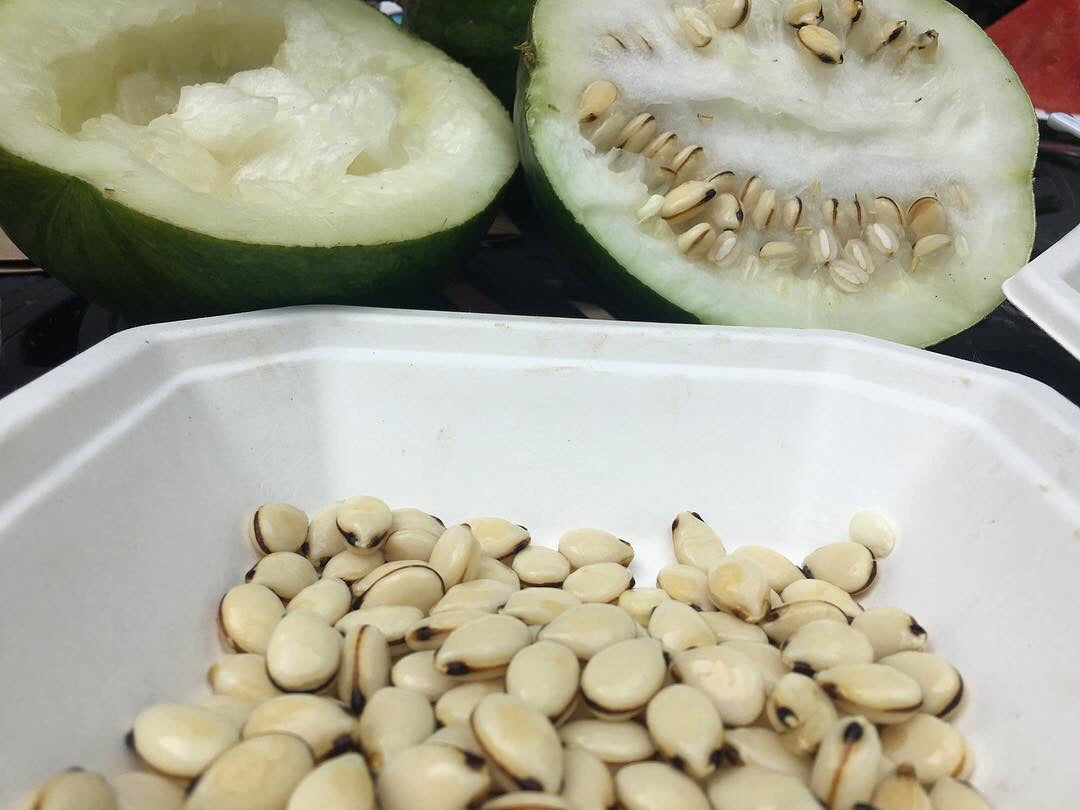
We are very grateful to have sourced our seed from Serendipity Seeds, who called this variety Egusi-itoo (Cucumeropsis mannii), though we believe this may actually be another Egusi species: Brown-Seeded Melon from Nigeria (Citrullus lanatus). The seeds are fat, white, and beautiful, and according to Truelove Seeds apprentice Amirah, who requested we grow this crop, the flesh is the essence of bitterness. We are so grateful that it seemed happy in our hoop house, and excited to deepen our relationship to its seeds and its story.

Known as: Egusi, Agushi, Egusi Bara, Gusi Abara, Bitter Melon

Thank you to Yemi Amu of Oko Farms for sharing some of this information with us!

Days to maturity: 120-160

Seeds per pack: 15-18

Germination rate: 84% on 11/07/2025

Planting / harvesting notes

Direct sow in warm soil after the last frost, or seed indoors 2-3 weeks beforehand and transplant. Space 18" apart in the row. Harvest fruits before first frost, or when the attached stem withers and turns brown. Use a sledgehammer or a rock to break open fruits on a tarp. Using a knife (as shown in our photos) slices many of the seeds.

Seed keeping notes

Squash are insect pollinated and require about 1/2 a mile of isolation from other varieties of the same species, which we believe in this case to be the same as Watermelon - Citrullus lanatus.The seeds will be fully mature when the fruit gets large and the stem withers. Separate the seeds from the flesh, rinse them, and dry them on a screen or paper product away from direct sunlight in a ventilated place. The plumpest and hardest seeds will be most viable.

Shipping Notes
  • Free Standard Shipping on $100+ Orders to the USA.
  • Except Preorder products are shipped in 48 hours.
  • Delivery to the USA:
  1. Standard Shipping : 3-10 business days
  • If time is of the essence, please consider selecting expedited delivery for faster service.
Exchange/Return Notes
  • We offer a 30-day return/exchange service after receiving.
  • Final sale items are not eligible for returns or exchanges.
  • To process your return/exchange, please contact us at [email protected]
  • Please click here for more details>>> Return & Exchange Policy
SKU: 29449579665

Discover Niche Categories That Outsell egusi seeds for planting

Top-Converting Item to Boost Your Average Order

4.3 ★★★★★
Based on 12 reviews
Sort
Highest Rating
Newest First
Oldest First
Product Reviews
A
Verified Purchase
Amazon Customer
Boise, US
★★★★★ 5
Inspiring and well-written
This is a very interesting book written by some Harvard profs. They did a large national survey of innovative businesses and their leaders. The book posits that innovative people follow five skills: associating, questioning, observing, networking, and experimenting. These skills can be found at the individual or organizational level. The idea is that most people have these skills in their DNA and can bring them out with some practice. There are a lot of interesting and inspiring examples like Steve Jobs and Jeff Bezos. Although this book seems like a self-help type book with a lot of hype, it has an academic underpinning. Any organization that is interested in promoting innovation could benefit from encouraging these 5 skills. If you are interested in innovation or creativity in business or any organization that produces something, you will like this book. The books is a little distracting to read because it has sidebars all through it giving interesting examples that break up reading concentration. Aside from that, it is a well-written book that is easy and enjoyable to read. I enjoyed the book greatly and found it to be inspiring.
WAS THIS REVIEW HELPFUL?YesReportShare
Reviewed in the United States on December 5, 2015
S
Verified Purchase
Stephen Collins
Omaha, US
★★★★★ 4
Great read and research. But what about daily application for regular people?
The research piece behind this book might be the next thing I read, as I'm intrigued by the academic rigor applied. The reveal and living examples of the five skills - questioning, networking, experimenting, observing and associating - are tangible and approachable given their articulation through well-known and highly visible entrepreneurs running innovative companies. There's much to be gleaned by looking at the way these people behave and, even through simple emulation, enhancing one's own skills. My only real disappointment with the book is its limited approach to practical, daily application for those not yet at the top of the tree. It's rather a different kettle of fish for the innovation-minded, but stuck in bureaucracy, worker who wants to make things better, is still motivated, and hasn't been crushed by the machine. How does that person actively innovate? And, in some cases, get away with it? This book (or an accompanying volume) focussing on daily, in-work, innovation would be useful.
WAS THIS REVIEW HELPFUL?YesReportShare
Reviewed in the United States on May 23, 2013
A
Verified Purchase
Annette
Massapequa, US
★★★★★ 5
A Favorite Book on Innovation
Format: Hardcover
Very well written and enough stories to help the true content stick. This is a favorite book of mine and has lead to interesting conversations to boot.
WAS THIS REVIEW HELPFUL?YesReportShare
Reviewed in the United States on September 29, 2025
K
Verified Purchase
Kurt Manwaring
Bozeman, US
★★★★★ 5
An exceptional five stars out of five
Few qualities separate inordinately successful entrepreneurs from the rest of the pack than the ability to innovate. Many have debated whether individuals are born with this quality or whether it can be nurtured. In The Innovator's DNA, Jeff Dyer, Hal Gregersen and Clayton Christensen explain that while genetics play a role, innovation is most certainly a skill that can be learned. In particular, the authors introduce and expound upon five "discovery skills" found in the leaders of some of the most innovative companies in the world: (1) associating, (2) questioning, (3) observing, (4) networking and (5) experimenting. Each discovery skill is accompanied by real-world examples and pragmatic exercises that make the book unusually valuable in an age where copious books on change, leadership and innovation overwhelm the already-overwhelmed executive. I give The Innovator's DNA an exceptional five stars out of five. The authors present a very readable book and provide concrete exercises for developing innovative skills. Using the principles provided in the book, I created a folder on my computer that I call my "Innovation Room." I use this to track progress as I work through various exercises and as I take time to ponder about how to apply innovative solutions to extant problems in Utah. This book was and will continue to be useful to me, and is recommended as a must-read for those interested in adding rare innovative attributes to their arsenal of problem-solving and decision-making skills. *NOTE: The preceding text is taken verbatim from my short book review printed in the June 2012 edition of Utah Business.
WAS THIS REVIEW HELPFUL?YesReportShare
Reviewed in the United States on March 22, 2013
K
Verified Purchase
Kocese
Fort Morgan, US
★★★★★ 3
It's Ok
It's an ok book and it definitely has some interesting things going on it, but it also has those "ask yourself" these questions if you can be an innovator which is where every human being ponders and talks themselves into having the type of characterisitic the question asks if they have and that makes that human being feel the best about themselves. Bottom line the book has some good info, is it better than say reading the biography of each innovator that they cover (if one is available)....I can't say that it is.
WAS THIS REVIEW HELPFUL?YesReportShare
Reviewed in the United States on May 2, 2013

recommand products