SKU: 64076352234
aloe vera plant max size

aloe vera plant max size Buy 'Large Aloe Vera Plants - Aloe barbadensis' Care and Growing Guide

Sale price$19.93 Regular price$22.15
Save 10%

Pay in installments of $5.54 with ShopPay, AfterPay and Klarna

Shipping Estimate
USA
  • USA
  • CAN

Ships within 48 hours · Estimated delivery Jul 27 - Aug 1

Promo Codes Available:

For Your Every Summer RSVP, with Code: SUMMER15

Description

aloe vera plant max size Buy 'Large Aloe Vera Plants - Aloe barbadensis' Care and Growing GuideIntroducing the fabulous Aloe Vera plant also known as Aloe barbadensis 'miller,' it is also known as a medicinal aloe and burn plant. The Aloe vera plant is by far the most popular out of over 400 varieties of the Aloe genus. This incredible tropical succulent is not your average houseplant. It's a superstar known for its leaves, which hold a magical aloe vera gel for soothing sunburn and as a popular drink to help your stomach. This large Aloe vera

Introducing the fabulous Aloe Vera plant- also known as Aloe barbadensis 'miller,' it is also known as a medicinal aloe and burn plant. The Aloe vera plant is by far the most popular out of over 400 varieties of the Aloe genus.

This incredible tropical succulent is not your average houseplant. It's a superstar known for its leaves, which hold a magical aloe vera gel for soothing sunburn and as a popular drink to help your stomach.

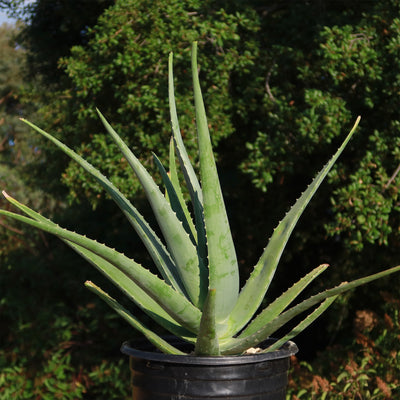
This large Aloe vera plant boasts fleshy lance-shaped grey-green leaves with small white teeth along the edges growing out from a starfish-like basal rosette. 

The edible aloe vera flowers burst into bloom in vibrant shades of yellow at the tips of their stalks when given favorable conditions. Only mature plants will yield flowers, so you'll have to wait at least four years to see an aloe vera bloom. However, in some growing conditions (especially hybrid plants), the flowers can sometimes appear with orange or reddish hues. 

This fast-growing succulent can grow into a large aloe vera plant up to 3 feet tall and 2 feet wide and even produce adorable pups that you can repot or share as delightful gifts with fellow plant enthusiasts.

How to Get Aloe Vera Gel from the plant to use on your skin

  1. Choose and Cut a Leaf: Select a large, healthy leaf from the bottom of the plant. Use a sharp knife to cut the entire leaf off at the base.
  2. Prepare the Leaf: Let the leaf sit upright in a container for 10–15 minutes to allow the yellow sap (aloin) to drain out. This sap can be irritating to the skin.
  3. Slice and Extract the Gel: For a small amount of gel, cut a section from the leaf rather than using the whole thing. Slice the leaf lengthwise to expose the gel. Use a spoon or knife to scoop out the clear gel.
  4. Apply or Store: Apply directly to your skin for soothing relief. Store extra gel in an airtight container in the fridge for a few days.

Aloe vera juice has many benefits for humans, this succulent rich in antibacterial, antioxidant, and anti-inflammatory properties, may enhance digestion, blood sugar levels, and oral health, although certain compounds, particularly aloin, may cause digestive discomfort and other side effects.

An aloe vera indoor plant is a great addition to any home, as it is easy to aloe vera care for and provides a variety of aloe vera benefits. 

According to the American Academy of Dermatology, Aloe vera has anti-inflammatory properties that can help in wound healing. It can also help to moisturize the skin and prevent peeling.

When and How to Water Your Aloe Vera 

As a desert dweller, watering the aloe vera succulent may be tricky, it may shrivel and die if given too little water, but it may also easily rot when given excessive water. So be careful not to overwater your aloe plantyou only want to give it enough to keep it from drying out completely, not drown it! 

A good rule of thumb is to water the Aloe plants deeply and then allow the soil to dry out completely before watering again. In the spring and summer, during the growing season, watering can be done once every 2-3 weeks.

During the winter months, when aloe vera is in a dormant period, it can be watered even less frequently. If you live in a rainy climate, consider planting aloe in gravel or stones. 

It is also important to note that aloe vera plants are sensitive to water quality. They prefer water that is low in minerals and salts, so it is best to use distilled or filtered water. Tap water can be used, but it should be left out for 24 hours before watering the plant to allow the chlorine to evaporate.

Light Requirements - Where to Place Your Aloe Vera Plant 

When growing indoors as a houseplant, place the aloe vera a few feet away from the south-facing window that receives plenty of sunlight, but it is important to avoid direct sunlight, as this can cause the leaves to burn. If the aloe plant is not receiving enough light, the leaves will start to droop and turn brown. In this case, it may be necessary to move the aloe vera plant to a brighter location. 

When planted outdoors, your Aloe plants need their daily dose of sunshine like a beach-loving teenager needs their favorite tunes!

They thrive on at least 6 to 8 hours of direct sunlight, soaking up those glorious rays with joy.

But wait, before you go dragging your aloe plant from its cozy shady spot into the blazing sun, be cautious. That sudden move can dry out your leafy buddy and leave it looking as yellow as a lemon.  

Now imagine you live in one of those cooler climates where clouds have permanent residency or if your home lacks these sunny windows altogether.

Fear not; you can use artificial lights – they're like little suns in bulb form! Hang them about one to two feet above your precious plant during daylight hours (that's roughly 16 hours per day) and watch it flourish happily amidst dim interiors.

Optimal Soil & Fertilizer Needs 

Aloe vera plants prefer well-draining soil that is a mixture of sand, perlite, and peat moss. It is critical to avoid soil that retains excessive moisture, as this can cause root rot. Instead, make or buy a well-draining potting mix, or ideally use our specialized succulent potting mix soil for aloe vera that contains 5 natural substrates and mycorrhizae to promote the development of a strong root system that helps your succulent to thrive.  

In terms of fertilizer, aloe succulents do not require a lot of nutrients. They can be fertilized once a year in the spring with a balanced fertilizer (NPK) of 5-10-5 in ratio. It is important not to over-fertilize the aloe plant, as this can lead to root burn. 

Hardiness Zones & More 

When grown indoors as a houseplant, aloe vera plants prefer a warm and dry environment. They thrive in temperatures between 60°F and 80°F. Aloe vera is a succulent, so it's adapted to arid conditions and doesn't do well in overly humid environments. Aim for a humidity level of around 30% to 40% for your indoor aloe vera plant.

In the United States, this is mostly an indoor plant, but if you live in southern Florida or Hawaii then you can cultivate it outdoors in USDA zones 9-11

Aloe vera can tolerate temperatures as low as 40°F for short periods, but prolonged exposure to freezing temperatures can damage or kill the plant. If you live in a colder climate, it's best to keep your aloe vera indoors or provide protection during winter months.

Aloe vera plants prefer dry air and do not require high levels of humidity. They can tolerate low humidity levels and do not need to be misted or placed in a humid environment. 

Wildlife - Aloe Vera Attracts the Following Friendly Pollinators

Aloe vera plants attract a variety of friendly pollinators, including bees, butterflies, and hummingbirds. These pollinators are essential for the reproduction of aloe vera plants, as they help transfer pollen between flowers, ultimately leading to the production of seeds. Additionally, these pollinators play a crucial role in maintaining biodiversity and ecosystem health.

Butterflies
Bees
Hummingbirds
Lady Bugs
Multi Pollinators
Other Birds

According to the ASPCA, the Aloe vera can be mildly toxic to pets and humans. It is rare but can occur if consumed in large quantities and can cause abdominal cramps, diarrhea, and electrolyte imbalances. It is important to consult a healthcare professional if you experience any adverse effects from consuming aloe vera.

How to Propagate Your Aloe Vera Plant

To propagate your aloe vera plant, you can separate the offsets or "pups" that grow at the base of the main plant. Gently remove these pups and plant them in their own pots with well-draining soil to encourage root growth. Water sparingly until they establish themselves, and place them in a sunny spot to promote healthy growth.

Aloe Vera: The Natural Sunburn Remedy


Aloe vera gel is known for its ability to moisturize the skin, it helps soothe burns and sunburns, as well as being known for its anti-inflammatory and antibacterial properties.

Aloe Vera is also rich in vitamins and minerals that are essential for healthy skin. It is best to use pure aloe gel extracted directly from an aloe vera plant.

To use aloe vera gel to soothe sunburns, cut off a piece of the large aloe vera leaf and open it to reveal the gel.

To maintain the aesthetic appeal of your aloe plant, it is advisable to cut off the entire leaf of the large aloe vera plant when cutting one. Just chop the leaf off as close to the main stem as you can. Cutting leaves from the base of the plant is always preferable. These leaves will be thicker since they are older. If you cut off the tip of a leaf, it will eventually turn brown at the tip because cut leaves keep their scars.

Key Takeaways

  1. Aloe vera is renowned for its medicinal properties, particularly its soothing gel, which is widely used for treating burns, wounds, and skin irritations. Its natural compounds, like aloin and acemannan, have anti-inflammatory and healing properties.
  2. When cut, aloe vera can seal its own wounds by producing protective latex, showcasing its remarkable survival mechanism in harsh environments.
  3. Aloe vera is not just a skincare savior; it also purifies indoor air by removing harmful pollutants like formaldehyde and benzene, making it a great addition to homes and offices.
  4. Native to arid regions, aloe vera thrives in minimal water conditions. It stores water in its thick, fleshy leaves, allowing it to endure prolonged droughts.
  5. The inner gel of aloe vera leaves is edible and used in drinks and food for its health benefits, such as aiding digestion, boosting immunity, and providing hydration. Always ensure proper preparation to remove any bitter or toxic compounds.
  6. The presence of yellow flower buds is a strong indicator of the edible variety.

The Bottom Line

Overall, Aloe vera is a popular plant known for its healing properties and versatility. It has gained popularity for its ability to help heal wounds, cuts, and burns, including sunburns. The gel inside the aloe vera leaves contains soothing and moisturizing properties that can provide relief and promote healing. In terms of care, aloe vera is relatively low-maintenance. It thrives in well-draining soil and requires moderate watering. It prefers bright, indirect sunlight but can tolerate some shade. 

A lot of people have a hard time finding large aloe vera plants, but here at Planet Desert, we regularly have large sizes in stock. Don't miss out on adding an Aloe vera plant for sale to your garden! Order now and enjoy its beauty for years to come. 

Shipping Notes
  • Free Standard Shipping on $100+ Orders to the USA.
  • Except Preorder products are shipped in 48 hours.
  • Delivery to the USA:
  1. Standard Shipping : 3-10 business days
  • If time is of the essence, please consider selecting expedited delivery for faster service.
Exchange/Return Notes
  • We offer a 30-day return/exchange service after receiving.
  • Final sale items are not eligible for returns or exchanges.
  • To process your return/exchange, please contact us at [email protected]
  • Please click here for more details>>> Return & Exchange Policy
SKU: 64076352234

Discover Niche Categories That Outsell aloe vera plant max size

Top-Converting Item to Boost Your Average Order

4.5 ★★★★★
Based on 9 reviews
Sort
Highest Rating
Newest First
Oldest First
Product Reviews
A
Verified Purchase
Alice Friedemann
Omaha, US
★★★★★ 5
How Corporate America created free-enterprise Jesus to undo the New Deal
This book tells the history of how corporate America have tried to undo New Deal reforms since the 1940s by creating a new free-enterprise religion, and to erode the separation of church and state. Corporate America’s creation of a free-enterprise selfish Jesus began in 1935 with the founding of an organization called Spiritual Mobilization. Some of the corporations who donated money to this and similar organizations include: American Cyanamid and chemical corporation, Associated Refineries, AT&T, Bechtel Corporation, Caterpillar Tractor Company, Chevrolet, Chicago & Southern Airline, Chrysler corporation, Colgate-Palmolive Company, Deering-Milliken, Detroit Edison, Disney, DuPont, Eastern Airlines, General Electric, General Foods, General Motors, Goodwill, Goodyear Tire & Rubber, IBM, J. C. Penney, J. Walter Thompson, Mark A. Hanna, Marriott, Marshall Field, Monsanto Chemical Company, National Association of Manufacturers, Pacific Mutual Life Insurance, Paramount Pictures, PepsiCo, Precision Valve Corp, Quaker Oats, Republic Steel Corp, Richfield Oil Co., San Diego Gas & Electric, Schick Safety Razor, Standard Oil Company, Sun Oil company, Sun shipbuilding company, Union Carbide and Carbon Corporation, United Airlines, US Rubber company, US steel corporation, Utah Power & Light, Warner Bros. Pictures, Weyerhauser. In the 1930s, corporations were well known to have brought on the Great Depression with their tremendous greed and dishonesty. The New Deal reformed the financial system, distributed wealth more evenly, provided a social safety net, protected the people by regulating businesses to protect them from unsafe and unhealthy food, drugs, and other products, toxic pollution, aided farmers in slowing soil erosion to prevent more dust bowls (and feed Americans for hundreds of years-- good topsoil is America’s most important treasure), and other public services that benefited everyone. The New Deal embodied the ideals of the Social Gospel, a movement dedicated to the public good, economic equality, eradication of poverty, slums, child labor, an unclean environment, inadequate labor unions, poor schools, and war (Wiki Social Gospel). Corporate America fought against these reforms and has been trying to undo the New Deal ever since then. One of their most successful tactics was getting religious leaders to spout a new version of Jesus – a free-enterprise, Ayn Rand, selfish Jesus and eradicate the Social Gospel Jesus of the New Deal. At first ministers and people saw through since this propaganda was obviously craven corporate self-interest. So the propaganda was crafted more subtly, and sold to conservative religious leaders. Congregations then listened to sermons about the free-enterprise Jesus with open hearts and minds, which they would have laughed at if the speaker were a CEO. The new religion taught them to hate unions, social welfare, to fear and hate government, to be against abortion and birth control (mainly because the more people there are, the less industries have to pay them). It was broadcast from conservative religious radio and TV stations, and in the secular world. This is why you don’t have a chance of talking Uncle Bob out of voting for demagogues at the Thanksgiving table – you’re attacking his religion and core beliefs he’s heard since his first sermon, and his brain shuts down in anger. He’s been taught since he was a baby that he should hate and fear government, not corporations. People like to say that capitalism is imperfect, but the best system that exists. Well, it’s great at raping, pillaging, and poisoning land, water, and air than any other system. Industrial farming is depleting aquifers and eroding and compacting top soil to the point where it won’t produce much food after centuries rather than millennia. Global conventional oil production, where 90% of our oil comes from, peaked in 2005 (Aleklett et al. 2012; Kerr 2011; Murray 2012; Newby 2011; IEA 2010; Zittel et al. 2013), declining at a rate of 6% now and increasing to 9% by 2030 (Hook 2009). According to the Department of Energy, you’d want to prepare at least 20 years ahead of time for peak oil (Hirsch 2005), yet here we are 12 years after peak conventional oil, with both Democrats and Republicans assuming that endless growth on a finite planet will fix things. We don’t have endless energy, it turns out that earth is not a giant gas tank, and even if it were, exponential growth would drain it in centuries. There isn’t a single endeavor that doesn’t depend on energy, especially supply chains, mining, logging, construction, and road building, which are done with heavy-duty trucks, which can only accomplish their work with diesel engines that burn only diesel (Friedemann 2015). Since the social net is funded by an ever-expanding working population and growth, social security and Medicare are Ponzi schemes, as well as our financial system, which depends on growth to pay back debt. The corporations are about to get the death of the New Deal they’ve so wanted via the decline of our fossil-fueled civilization. There is no political party that can fix this, so it’s time to strengthen your community to become more resilient, self-sufficient, and able to supply food and other essentials locally. To fix water and sewage infrastructure. It’s time to embrace the social gospel and help community members less fortunate than you in the years ahead. Aleklett, K., et al. 2012. Peeking at peak oil. Berlin: Springer. Hook, M., et al. 2009. Giant oil field decline rates and their influence on world oil production. Energy Policy 37(6):2262–2272. Friedemann, A. 2015. When trucks stop running, Energy and the Future of Transportation. Springer. Kerr, R. 2011. Peak oil production may already be here. Science 331:1510–11. Murray, J., et al. 2012. Oil’s tipping point has passed. Nature 481:43–4. Newby, J. 2011. Oil Crunch (Fatih Birol). Catalyst. ABC TV. IEA. 2010. World energy outlook 2010, 116. International Energy Agency. Zittel, W, et al. 2013. Fossil and nuclear fuels. Energy Watch Group.
WAS THIS REVIEW HELPFUL?YesReportShare
Reviewed in the United States on January 9, 2017
S
Verified Purchase
Star Quest
Massapequa, US
★★★★★ 4
Very Interesting and Important Book
Format: Hardcover
It took me a long time to read this book, but I highlighted and took notes all over it. It’s absolutely fascinating and well researched and I personally think it should be required reading in seminaries across the nation. Understanding how Christianity as a religion penetrated the fabric of American politics after FDR’s presidency and the New Deal is an important part of understanding American politics in the first place. I also realized what bothered me about this in the first place. Our founding fathers specifically wrote the bill of rights and the constitution to protect freedom of religion and also to keep it out of state affairs. This unfortunately is not what happened throughout the last 60 years. It is clear that prominent Christian figures throughout the decades have infiltrated American politics, some more than others. In my younger years I was oblivious to this and in some instances promoted American Christianity in the political discourse. After many years of intense research and study I understood why that is not healthy for our republican constitutional form of government. Ever Since president Regan said the famous words “God Bless America” at the end of a speech, the phrase has been shoved down the ears of the American populace over and over again by political leaders to this very day. The playing of the National Anthem synonymous with “God Bless America” phrases and tunes has also in my opinion and observations, contributed to religious nationalistic patriotism. And although I am by no means against loving and appreciating one’s country, I also see the coercive methods of these efforts and am concerned that is creates a blind sense of obedience to the state under a religious umbrella which tarnishes Christianity as a whole. I also acknowledge that having the state influence, dictate and decide what is right for our lives is just as unhealthy and dangerous. If looked at from a practical standpoint, understanding the founding documents of our nation’s founding and establishment is exactly what keeps the healthy political balance alive. I did have one issue with the authors writing and interpretation which significantly bothered me. The author categorized members such as Billy Graham and James Fifield among other pioneers of the movement as Christian Libertarians. I wholeheartedly disagree with that title. If one studies and understands the core of what Libertarianism is about, it is specifically against forcing or coercing any particular religion regardless of political or social means especially through the state. Libertarians acknowledge the right to believe in a religion or no religion. The fact that Reverend Graham utilized his religious position to influence politics is very much anti-libertarian and a vast majority of libertarians will very likely agree with that position. I suggest the author study libertarianism a bit more and do more research before tainting that label. Despite that hurdle, I still thought this was a very good and important book.
WAS THIS REVIEW HELPFUL?YesReportShare
Reviewed in the United States on May 11, 2019
J
Verified Purchase
Jon Becker
San Leandro, US
★★★★★ 5
Essential History for Retaining Reason and Rationality for Guiding the Nation
Awesome book on the History of people, themes and big money, corporate used in an attempt to make one religion the National Religion while neutering the First Amendment. It is true to it's title in detailing how Corporations and Religion came together to fight the New Deal of FDR. These two self serving entities fought for control of the people but did almost nothing to avert wide spread hunger and homelessness in the depression. The fortunes of corporations and insistence of religions on controlling the minds of people to produce jobs in their own occupations outweighed the immediate needs of the jobless and homeless. The opulent lifestyles of the big religions and their organizers came first over the health and welfare of the country, just like it had in Medieval Europe, where the Aristocrats and the Christian Churches ran the Continent. These two institutions were responsible for keeping Democracy out of Europe and ultimately creating the Soviet Revolutions in Russia that attempted to spread to the rest of the World. What is clear, from many books on this subject, that "Under God" means being subservient to God, the word of which comes from God's messengers. Subservience Under God means that when the opinions of the People differ from those of God as told through the Messenger, then God wins and the People Shut Up. Those that don't face stiff penalties. Fabulous History that everyone should know if they want to perpetuate a Democracy. The Roman Empire was "One Nation Under God", because the Christian Religion was the only legal Religion and it had only One God - no others were allowed and this was enforced with the sword. Rome will return to America if we are not careful.
WAS THIS REVIEW HELPFUL?YesReportShare
Reviewed in the United States on October 22, 2015
M
Verified Purchase
Michael Keller
Lake Worth, US
★★★★★ 3
Stranded on third base
Format: Hardcover
Prof. Kruse wanders away from the promise of the subtitle of his book--"How corporate America Invented Christian America." He almost gets there when he describes the ideological opposition of the wealthy to F.D.R's "New Deal." and their caricature of the "social gospel" as Communist propaganda. His description of Truman's encounter with Billy Graham is wonderful. For a book published in 2015, Kruse makes only slight mention of the fact that the politics of money and religion in contemporary times becomes more pernicious every day. The main body of the book drifts into redundant detail about "who prayed with who" and the spiritual influence of prominent evangelists on presidents from Eisenhower to Bush with only faint reference to their ties with the Capitalist agenda. He portrays wealthy Christians as true religious zealots when, in fact, they and many of the politicians they supported were likely hypocrites using religion as a wedge issue to increase their power and pursue their agenda of unregulated Capitalism. It is remarkable that Kruse entirely fails to mention the Koch brothers--billionaires who bankroll countless ultra right-wing politicians with evangelical agendas, while they, themselves, are apparently Ayn-Rand-style libertarian atheists interested only in a social-Darwinian, Capitalist heaven. Prof. Kruse leaves us stranded on third base, when he could have hit a home run!
WAS THIS REVIEW HELPFUL?YesReportShare
Reviewed in the United States on May 7, 2015
S
Verified Purchase
SalliForth3
Los Angeles, US
★★★★★ 5
Horrific Voter Suppression
Format: Paperback
This is a very well documented book about voter suppression in America. It was interesting to see that before the Jim Crow era, black people voted, were elected to office, got educations and did fairly well. With Jim Crow, horrific voter suppression began (lynchings, etc.). In the early days it was the Southern Democrats and the KKK. As time went on the methods simply became more devious. In the 1930s FDR began attempting to attract black voters to the party. By the end of WWII we had "Dixiecrats". By the time the time the Civil Rights Act was passed, the transition was complete and those Southern Democrats were now members of the GOP. (Much of that bit of history is not in the book, but you'll want to look it up.) The GOP is now the master of voter suppression, and you can see it pretty much everywhere but especially in Georgia, Texas, Minnesota and many southern states. The book is chock full or examples, case histories and stories of resistance. It made me want to sell my house and give the money to the ACLU, NAACP, and SPLC to defend our most precious right (not privilege) to vote.
WAS THIS REVIEW HELPFUL?YesReportShare
Reviewed in the United States on October 4, 2020

recommand products