SKU: 10440894628
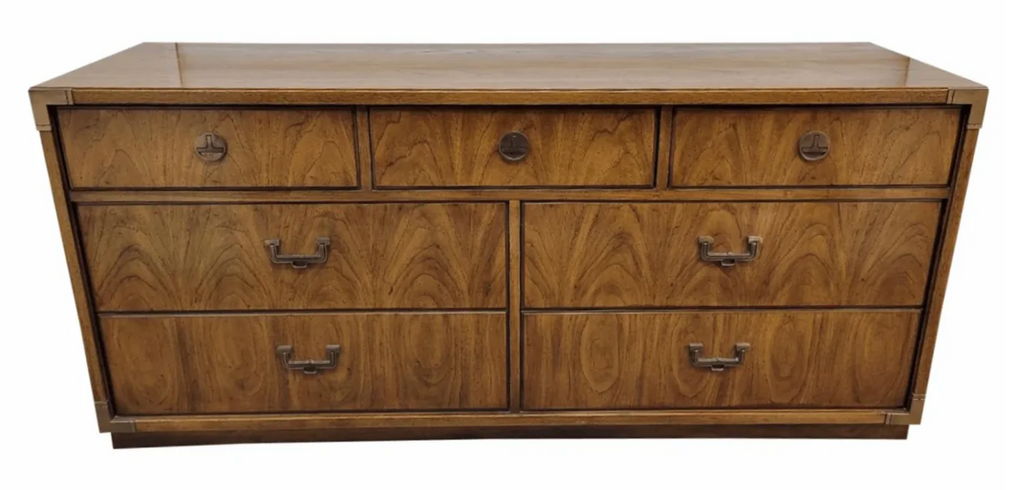
thomasville vintage dresser

thomasville vintage dresser Vintage Thomasville Huntley Campaign Style Wood Dresser Available for Custom Lacquer! – Hibiscus House

Sale price$24.89 Regular price$27.66
Save 10%

Pay in installments of $6.92 with ShopPay, AfterPay and Klarna

Shipping Estimate
USA
  • USA
  • CAN

Ships within 48 hours · Estimated delivery Aug 22 - Aug 27

Promo Codes Available:

For Your Every Summer RSVP, with Code: SUMMER15

Description

thomasville vintage dresser Vintage Thomasville Huntley Campaign Style Wood Dresser Available for Custom Lacquer! – Hibiscus HouseVintage Thomasville Huntley Campaign Style Wood Dresser Available for Lacquer We love a campaign style vintage dresser and this one by Thomasville part of the Huntley collection is beyond chic and gorgeous on every level! Seven drawers in total, this all wood and dovetailed dresser functions beautifully and has fabulous brass details throughout which will be painted in our gloss gold. Use in any style home as a living room console or bedroom dresser!

Vintage Thomasville Huntley Campaign Style Wood Dresser Available for Lacquer// We love a campaign style vintage dresser and this one by Thomasville part of the Huntley collection is beyond chic and gorgeous on every level! Seven drawers in total, this all wood and dovetailed dresser functions beautifully and has fabulous brass details throughout which will be painted in our gloss gold. Use in any style home as a living room console or bedroom dresser! Add legs to this piece for height and an elevated look. This piece is raw and available for lacquer customization. Additional photos are for lacquer inspiration. The price includes one stock lacquer color, but a custom color can be selected for a $175 upcharge. Please note your lacquer color in the notes section at checkout should you know it, or let us know within three weeks of purchase! 

Measures: 62.75ʺW × 19ʺD × 29.25ʺH

We know it's difficult to decide COLOR! If you are certain you'd like a piece, but need some time to decide your lacquer color, go ahead and purchase the item so it doesn't get away from you and it’ll reserve your place in our paint line! Please let us know your color choice within three weeks of purchase. If it takes longer than three weeks to select you color your lead time will begin based on the date paint color is submitted in order to keep our operations in Florida on track. We recommend picking up paint swatches from your local paint store to see a color in your home if you’re unsure of a shade! Lighting in individual homes can impact the way the color appears.

This piece is currently in vintage condition and will be professionally refinished in high gloss lacquer. The price includes one of our stock lacquer colors. Our professional painters use a quality, high- gloss customized lacquer to transform these fabulous vintage pieces. If you would like custom color, please add the "custom color" product to your cart and "note" your Benjamin Moore or Sherwin Williams color code in the notes section upon checkout ($175 upcharge). Please type your color choice in the “note” section found beneath the piece on the left hand side on the cart checkout page should you know it or respond to our thank you email with your choice within 3 weeks to keep your spot in our paint queue. All original hardware will be painted in gloss gold unless specifically requested by the client or the product descriptions says it's eligible for lucite.

Turnaround time for all custom work is an estimate. We suspect lacquering will take anywhere from 8 to 12 weeks and shipping can take up to 2-3 additional weeks. Paint times can be impacted by the volume of orders received at a given time and are always estimates. Should your order fall within a time frame of typical calendar vacations and holidays expect a slight delay to allow our team and shippers to properly take time off to be with their families. Should you be customizing your piece with client sent wallpaper or hardware we must have that in hand prior to your piece going into production otherwise it may cause delays. All timeframes are estimates and subject to change due to the finicky nature of lacquer and working with vintage pieces, some pieces need additional time to cure. Our team will update you once your piece is pulled for paint and provide updates on shipping throughout that process. Clients are able to estimate their lead times based on the timeframes listed above.

Your shipping quote includes ONE small business private shipper hired on your behalf to safely hand- deliver your piece to the GROUND FLOOR/ FOYER of your home. Shipping rates include ground floor/foyer delivery only as we do not offer white glove shipping. We partner with some amazing, independently contracted shippers, and that being said most of them travel alone. They are unable to carry pieces up stairs to your foyer if there is not someone there to assist them. If you desire to have your piece placed in a specific room on the ground floor it is beneficial to have an additional pair of hands available to help AND tip the shipper.

Once your piece is picked up and securely blanket wrapped, you will hear from our Hibiscus House team but the shipper will be your main point of contact for receiving. We ask that our shippers remain in close contact with our clients, but sometimes routes change for a variety of reasons causing delays or different arrival dates. These shippers are on tight timelines and can usually NOT reschedule. We suggest having a neighbor or family member, a garage code, etc. as a backup plan if you're unable to meet the driver. We continue to work to get your piece(s) to you as quickly as we can. Once your new piece has left our shop, if there is a delay in getting it to you, the shipper will reach out to you directly. We have little control over the piece once it has been turned over to the shipper. The shipper will have a Bill of Lading for you to sign off on upon the arrival of your piece. This indicates that you accept delivery and the condition of your piece at the time of its arrival. Should any issues be noticeable they need to be pointed out to our shipper or owner, Elizabeth, at 407-927-6080 as soon as possible. 

Yes, we ship anywhere in the continental U.S. (excluding Hawaii and Alaska.) If you experience shipping rate issues upon checking out, please e-mail or direct message us and we will try to work with our shippers and accommodate! 

Please keep in mind all sales are final. We can not offer returns or refunds as each piece is custom specifically for you. These are vintage pieces and most are between 50-70 + years of age. All vintage and handprinted items will have some imperfections and it’s not uncommon for newly finished lacquer to have slight imperfections upon arrival. For that reason we include touch up paint and instructions for use with each piece going out! For specific details on the quality of the specific product being purchased please read the first paragraph of the listing where we specify its craftsmanship! If the piece is all wood with dovetailed joints that will be indicated within the description of the product. Those that don’t specify this craftsmanship may not be all wood. Thank you for trusting our team to create something beautiful for your home! 

Shipping Notes
  • Free Standard Shipping on $100+ Orders to the USA.
  • Except Preorder products are shipped in 48 hours.
  • Delivery to the USA:
  1. Standard Shipping : 3-10 business days
  • If time is of the essence, please consider selecting expedited delivery for faster service.
Exchange/Return Notes
  • We offer a 30-day return/exchange service after receiving.
  • Final sale items are not eligible for returns or exchanges.
  • To process your return/exchange, please contact us at [email protected]
  • Please click here for more details>>> Return & Exchange Policy
SKU: 10440894628

Discover Niche Categories That Outsell thomasville vintage dresser

Top-Converting Item to Boost Your Average Order

4.4 ★★★★★
Based on 26 reviews
Sort
Highest Rating
Newest First
Oldest First
Product Reviews
G
Verified Purchase
GiveHerAGoodMunchin
Natrona Heights, US
★★★★★ 5
Excellent trilogy. This is book 2
Format: Paperback
Bob Monroe is an OG OBE G. Love this trilogy. If you can read, read this
WAS THIS REVIEW HELPFUL?YesReportShare
Reviewed in the United States on August 25, 2025
J
Verified Purchase
Joe Neal
Pawtucket, US
★★★★★ 5
Great (excellent) details for the date written
Format: Paperback
NOTE: I toned this version down in 2021 – I was in a bad place when I wrote the original and there were some hostile and entirely inaccurate personal remarks in it. A few tables/charts with a wealth of information have tiny text but most of this was easy enough to read. The photos are poorly produced (at least in the paperback version I reviewed), which is sad given they would be so handy otherwise. This is a classic post-war treatise on the weapons used for ground warfare during World War II by the U.S. Army and as such the Marines. It was first published around 1947 when the war was fresh and doubtlessly numerous technical details were still classified. It was written by a man intimately involved in many design projects. The coverage pretty much explains the breadth. Examples of use are included for some weapons and detailed tables of data for many. He explains references to the "long primer" for the 76-mm gun and the 81-mm mortar T1 extension tube. I am happy to have bought it for that and numerous other details. One thing I missed when I first wrote the original rambling, a bit over the top review back in September 2015 was that the 57mm M1 antitank gun is not mentioned even though it was a key component of Infantry weaponry in 1944-45, sometimes maligned but often quite effective when carefully used as noted in many, many detailed accounts. Perhaps it was skipped because it was a revision of the British 6 pounder and not designed by Barnes men? Yet, it is an example of the issues caused by the pre war budget minders forcing the Army into desperate choices as explained later – and the using arms who decided to adopt it almost at the last minute, late in 1943. Until a weapon is adopted by the Army ammunition cannot be developed – it costs too much money and time to do so. Most of the book is positive and ignores failures, posed from the viewpoint of a proud designer not an actual user. Yet those failures illustrate the issues Ordnance had to deal with during the war. The U.S. invented the bazooka as the 2.36-inch model in 1942 yet the Germans fielded the more powerful 8.8-cm (88mm) model in 1944; and the U.S. did not get the 3.5-inch (90mm) into production-ready state until the war was ended. This was caused by offloading development onto people who went out for a “super rocket launcher” that had no place in the war. All too often, some excited designers did indeed get ahead of themselves when it came to what worked but was a bit too much (and ultimately impractical for the Army at the time). The inability to develop hollow-charge (HEAT) ammo for cannon and howitzers to reach its minimum potential (twice the caliber in penetration or better) was common for all countries including the U.S. The 105mm howitzer round was pretty good and while disparaged by all and sundry even the 75mm howitzer’s shell could (and did) take out medium armor. Barnes refers to the M3 and M5 light tank as "excellent" when the tanker's epithet would have been "tin plated coffin with a pea-shooter". Here we have an issue with comparing numbers such as armor thickness and penetration power of guns to facts; it is common to think they were butchered such as in Africa when in fact they fought well enough, flaws and all. But they were not the weapons the tankers wanted (nor deserved), and thus tanker’s complaints were valid. And, yes, they were not seen as a prime resource for fighting German tanks and hence reverted to recon and infantry support roles. Where they continued to meet and destroy German armor (but also be destroyed). Any German field commander would have loved to have a battalion of M5s on hand chasing down and chewing up U.S. troops; the contribution of the men in the light tanks in Europe in 1944 and 1945 is all too often belittled by the “number nerds” who toss the light tanks off as useless. They were anything but useless. Why were the M10, M18, and M36 designed as “Gun Motor Carriages” and not tanks? Because they were developed for the tank destroyer forces and the very bigoted officers who held the most sway on development wanted them to be nothing but “motorized antitank guns”. If they had been designed as tanks that would have invalidated Tank Destroyer Doctrine immediately. And yet, in the end, the men doing the fighting needed and wanted tanks, so they used them as tanks as much as they could, despite the open roof and lack of internal machine guns. It is claimed the gun motor carriages were cheaper than tanks (a specious argument given price varied by manufacturer and ultimately depended more on quantities produced not some arbitrary raw number) but to produce the gun motor carriages for a specialist role that was neither tank nor artillery (albeit they were used for both) was a costly thing to do. The failure to develop a better light tank in time is not mentioned even though the T7 light tank with a 57-mm gun was ready in mid-1942 and could have been in the field around 1943 (the Armored Forces botched that one). The M24 was a nice tank but too late simply because development came too late because development had been stunted badly by congress and it’s miserly pre-1941 budget. There are errors: The design of the M24 began in 1943, not 1945. The 76-mm gun could hardly penetrate the "...heaviest German tank armor." But it could penetrate a lot of armor and the myth that all German tanks were Tigers and Panthers is one of those fantasies of the war pursued by people who are glorifying the war not understanding it (most German armor was medium or lighter), let alone the myth that they were always met head-on is ridiculous. The 90-mm gun was not optimized for anti-tank use and hence had the same issues with dealing with the frontal armor of the Panther (though it could handle the Tiger) and yet was better at that than many other guns. The tendency to adapt anti-aircraft guns for anti-tank guns was common and is where Germany got its 88s and the 128mm. The U.S. found it did not need a lot of 90mms (the homeland was not threatened and what it produced was enough for its needs); there was never the demand for a higher altitude version and hence nothing like the 8.8cm FLAK 41 was developed which led to the 8.8cm Kwk43 and Pak43s; yet Ordnance built their own versions of hot 90mm for tank use. I missed the boat in my original review failing to detail how the Army’s main issue was the budget provided by Congress and politicians from 1920 through 1940. They starved the Army; the U.S. was peaceful and they had no interest in making it a military country and as such kept the Army small (and starved the air forces and Navy as well but not as badly). This crippled development; while the Soviets started building a modern Army in 1930 complete with investment in tank forces and tank arsenals; the Germans in 1934 or so; and British in 1934 or so; the U.S. politicians did not begin serious spending on the Army until 1941. Before then, the budget was all about “beans, bullets, and bayonets” and of course bodes to wield them. The Army had to struggle with what it had and put to field what was practical not what was best. Thus, for example, the recoilless rifles (used by the Germans in 1940) did not arrive in U.S. use until 1945. And yet a U.S. officer bult the first recoilless rifle to be used way back around 1916. Indeed, a brief little discussion on how the U.S. produced what it did based on budget would have opened many eyes. The Soviets produced so many thousand T34s for example, more than the U.S. – and in the U.S. the budget people were always saying, “You don’t need any more, stop building them!” As mentioned, the number of 90mm AA guns the U.S. produced was not based on manufacturing capacity but because they didn’t need more. Thus - there is a lot of information and many details many people will never have heard before. There are also many missing details concerning the Ordnance Department struggles to get things done in a very brief time frame thanks to how Congress had refused to let them do anything earlier. Dig into that deeper and you might find it nauseating the way people played games that hindered the U.S. Army in its job of helping beat the Germans. And sometimes couldn't put 2 and 2 together to get the right answer. But, they were human after all, and people do make mistakes. In my original review I argued that “If you want a politics free book you will not get it in this once, not unless you shut your eyes and remain ignorant . . .” but that is wrong. If this was a political book, Barnes might have ripped the budget mongers of the 1920s and 1930s a new sphincter for leaving the Army (and U.S. military as a whole) in such a bad situation as they did when war broke out. But, Barnes had more class than I do.
WAS THIS REVIEW HELPFUL?YesReportShare
Reviewed in the United States on September 19, 2015
P
Verified Purchase
Petey K
Boise, US
★★★★★ 5
Good content, very small print and photos
Format: Paperback
Get a magnifying glass… the print is tiny. They must have made this book to be a large hard cover because both the print and the photos are so small in paperback. Content looks decent. It’s a gift for my grandson who will probably spend more time with the photos than the reading anyway and his eyesight is better than mine. :D
WAS THIS REVIEW HELPFUL?YesReportShare
Reviewed in the United States on December 16, 2025
M
Verified Purchase
Museum Man
Bozeman, US
★★★★★ 4
Printing not up to standards.
Format: Paperback
Printing and pics not up to par.I gifted this book to a coworker and he was not as picky as I.
WAS THIS REVIEW HELPFUL?YesReportShare
Reviewed in the United States on March 8, 2020
T
Verified Purchase
TDD
Dallas, US
★★★★★ 5
Excellent resource
Format: Paperback
Purchased for my teenage son's history research project. Nice compilation, good information and well illustrated.
WAS THIS REVIEW HELPFUL?YesReportShare
Reviewed in the United States on May 29, 2025

recommand products