SKU: 32697208808
vintage victorian dresser

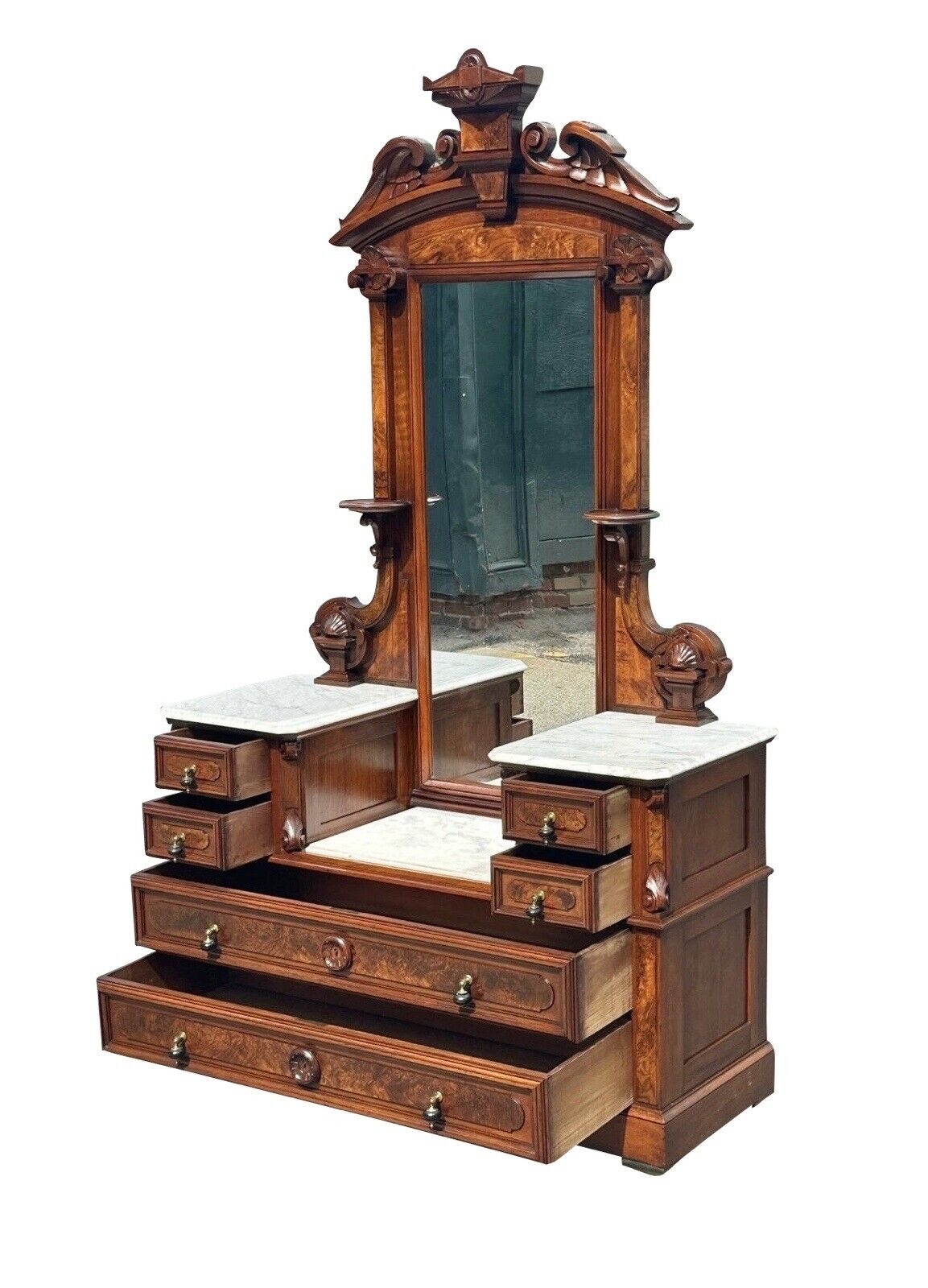
vintage victorian dresser Antique Victorian Burled Walnut Marble Top Dresser With Fine Shell Carved Mirror

Sale price$24.86 Regular price$27.62
Save 10%

Pay in installments of $6.91 with ShopPay, AfterPay and Klarna

Shipping Estimate
USA
  • USA
  • CAN

Ships within 48 hours · Estimated delivery Aug 21 - Aug 26

Promo Codes Available:

For Your Every Summer RSVP, with Code: SUMMER15

Description

vintage victorian dresser Antique Victorian Burled Walnut Marble Top Dresser With Fine Shell Carved MirrorWith our absolute highest compliments Bay Colony Antiques takes the utmost pleasure in offering this remarkable and important late 19th century Victorian era marble top dresser. This example is perhaps one of the finest dressers of its kind ever produced in the New York City area and it worthy of being represented in any important collection or institution which has a focus on exemplary late 19th century furniture and decorative arts. The dresser has

With our absolute highest compliments Bay Colony Antiques takes the utmost pleasure in offering this remarkable and important late 19th century Victorian era marble top dresser. This example is perhaps one of the finest dressers of its kind ever produced in the New York City area and it worthy of being represented in any important collection or institution which has a focus on exemplary late 19th century furniture and decorative arts. The dresser has remained in near pristine condition throughout generations of ownership and is as magnificent as the day it was made. It has been our privilege throughout decades of business to furnish Victorian homes throughout the country; from our local communities in New England to as far away as Louisiana, Texas, and California. For this reason, we always include choice offerings in our online antique catalogues of premium Victorian furniture for every room in the home. In our continual pursuits of the finest grades of Victorian furniture, either offered on the antiques market or exclusively in private collections, we have come to greatly admire the work of one particular artisan, Thomas Brooks of New York City. We distinguish the Thomas Brooks of New York City from another furniture maker of the same name active in the production of Victorian era furniture who was located in Connecticut. We have offered the later Thomas Brooks furniture as we have found it, primarily identified by paper labels inside the case of furniture or so attributed by nearly identical examples we have found unlabeled yet so close in design to known examples as to be unquestionably produced by the same maker. Recently we had a Victorian Sow Belly Parlor Table with a drawer accessible from either side of the table which went to a wonderful collection in New England that was a product of the Connecticut maker. It is unclear to us if there is a familiar connection between the two furniture makers or if by coincidence they both have the same name. We do feel the importance of signifying the difference between both cabinetmakers as to not confuse those who are unfamiliar with either party and are relying on search engines to gather more insight.

Thomas Brooks of New York City was perhaps one of the finest furniture makers of the late 19th century and is largely overshadowed by the better-known Victorian period designers such as R.J. Horner, John Henry Belter, & Joseph Meeks just to name a few. In the recent decades a stronger following for Brooks' works has emerged with examples selling at auction for commanding prices. We are actively in pursuit of anything possibly made by his firm as we feel it has remained undervalued for a long period of time and will retain its value or appreciate better compared to the famous workshops that produced furniture which is far out of reach of ordinary antique collectors. In our experience most of the works produced by Thomas Brooks is unlabeled but can be attributed through quality comparison and certain stylistic elements which are a common thread on his workshop's walnut furnishings. Two features we always search out are raised double ended tombstone panels in burled walnut affixed to the front of drawers and a particular stylized walnut leaf carving generally used as an ornament on various places throughout the exterior.


This dresser is primarily walnut with burled walnut veneers used to provide contrast on accent panels on the drawer faces and along the frame. The dresser is constructed with a drop well configuration which features three individual marble tablets that all original. Four smaller drawers are housed above two long drawers each of which is fitted with an ebonized drop pull with Eastlake brass stylizations. The sides are constructed with a frame and panel which allows for continual wood movement as the dresser experiences seasonal changes in relative humidity and the dresser features a well pronounced baseboard molding. This dresser is made complete by the presence of a commanding mirror which is enhanced with candle cup accents and interesting shell carved motifs. The architectural form of the mirror crest is further embellished with angelic wings which are clearly the product of a master carver likely in the employment of Thomas Brooks. The entire piece is sturdy and will provide the next owner with generations of continual use and is well suited for daily use. This dresser is equal parts functional furniture as it is an artistic achievement in the medium of walnut with the finest carving work and overall mastery of aesthetic design that a collector can hope to find from any work of the late 19th century. The dresser measures 54" wide x 20" deep x 91" tall to the very top center of the mirror. The marble ends measure 33 3/4" tall off the floor.


Shipping Notes
  • Free Standard Shipping on $100+ Orders to the USA.
  • Except Preorder products are shipped in 48 hours.
  • Delivery to the USA:
  1. Standard Shipping : 3-10 business days
  • If time is of the essence, please consider selecting expedited delivery for faster service.
Exchange/Return Notes
  • We offer a 30-day return/exchange service after receiving.
  • Final sale items are not eligible for returns or exchanges.
  • To process your return/exchange, please contact us at [email protected]
  • Please click here for more details>>> Return & Exchange Policy
SKU: 32697208808

Discover Niche Categories That Outsell vintage victorian dresser

Top-Converting Item to Boost Your Average Order

4.5 ★★★★★
Based on 12 reviews
Sort
Highest Rating
Newest First
Oldest First
Product Reviews
C
Verified Purchase
Carol
Carnegie, US
★★★★★ 5
Need to read book
Format: Hardcover
The truth about the Native people. THANK YOU Kent for writing this book. We purchased about 12 total.
WAS THIS REVIEW HELPFUL?YesReportShare
Reviewed in the United States on November 24, 2019
W
Walter Echo-Hawk, author of THE SEA OF GRASS.
Draper, US
★★★★★ 5
Native American history at its best!
Format: Hardcover
Kent Blansett's engrossing story about the life & times of the famed Mohawk activist Richard Oakes is Native American history at its best. I appreciated the well-written context provided about the birth, growth and impact of the Red Power Movement and the pivotal role that social justice activism played in the rise of modern Indian nations in the United States today. This scholarly work helps us understand modern Native America and is a "must-read" for every Native American Studies student and scholar, as well as readers interested in important American social justice movements.
WAS THIS REVIEW HELPFUL?YesReportShare
Reviewed in the United States on April 1, 2019
P
Verified Purchase
Par
Lowell, US
★★★★★ 5
Excellent book on ML
Format: Paperback
This is a great book on machine learning. Topics covered are extensive - from beginner level to advanced topics including math behind different algorithms. However, not "all" algorithms are covered. Please go through the table of contents. The first part - 11 chapters - covers machine learning concepts and second part covers advanced topics with Pytorch. There are lots of excellent code and they work!! The quality of the book I received is excellent. I have gone through all 742 pages, and it has held up very well!! I used Jupyter notebook to run all examples. I created a new notebook and copied and pasted the code and ran them. This approach worked very well for me. At the same time, I could experiment with my take on the code snippets and definitely added to my knowledge. Only issue I have is on the second part of the book discussing PyTorch: (1) Some packages are a bit older version: e.g., transformer 4.9.1 whereas current version is 4.48+. It took some tweaking/recoding to get the examples working. (2) There is not much discussion on why certain architecture was chosen - e.g., number of layers, is there a rule of thumb on how to improve performance by changing these parameters? Even with CUDA the code run for a long time. Therefore, experimenting with different values of parameters become too time consuming. (3) On the same note, if I can achieve test accuracy of 90%+ using logistic regression and almost the same (perhaps one or two percent better with PyTorch with IMDB movie review dataset and that two much faster why should I use PyTorch for this dataset? Obviously, PyTorch is for certain types of problems. Discussions can be included by not adding to the exhaustive (and apt) contents. Personally I was disappointed by lack of any example on time series. Must have for ML practitioner as a reference and guide.
WAS THIS REVIEW HELPFUL?YesReportShare
Reviewed in the United States on December 20, 2024
R
Verified Purchase
Richard Hackathorn
Waukegan, US
★★★★★ 5
Excellent Textbook for Hands-On Learning of ML
Format: Kindle
This textbook is for the serious life-long learners of machine learning. There are at least two ways to ‘consume’ this book. For the expert in ML, this is a textbook to study as a clear comprehensive ML overview and then to dive into sections of interest or ignorance. The concepts are grounded in code examples and are well cited (with links) to sources. Further, this textbook is appropriate if you are TensorFlow-centric and want to broaden into cutting-edge ML models/tools coded in PyTorch. For a new learner to ML, this is a textbook to DO (not just READ) with hands-on and brain-engaged. If you realize that ML is a key life-long skill for your career, consider this textbook as part of a daily learning habit (10-30 min). From personal experience, my advice to the new learner is as follows… First, clone the GitHub repository, setup your Python environment, and study the textbook, while working through the notebooks. Go on tangents and break the code. Do this methodically as part of your daily learning habit, but do not hesitate to jump ahead several chapters to prepare for tomorrow’s meeting. There is enough excellent material here for a full year of ML adventures. I did a similar strategy with Raschka’s first textbook. About four years ago, I had finished Andrew Ng’s Deep Learning Specialization as a student in his first cohort. I knew the concepts well but could not do the actual application coding. I was surprised how my Python coding improved by following Raschka’s clean and elegant style. And Raschka’s code examples were meaty enough to be springboards into working applications. Several textbook editions later, what is different about this new edition? First, it moves you through scikit-Learn (a firm foundation) to PyTorch, instead of TensorFlow. PyTorch is a better stepping-stone, both conceptually and practically. With PyTorch, you will go further with less energy, while being able to convert your efforts into TensorFlow as needed. In addition, most of the cutting-edge ML/AI/DL research is in PyTorch. It is nice to read a recent arXiv paper, clone their repository, click on the Colab tutorial, and replicate their experiments, along with picking up a ton of new coding tricks & tips. I am excited to work through these PyTorch sections to hone my skills. Second, there is a clear recognition of model tracking and tuning practices. This is often a gap in other ML textbooks and courses. Once you progress beyond the simple demo examples in a lecture, you realize that the real work is experiments, more experiments, and still more experiments, so that you must understand what the model architecture and hyperparameters are doing to your dataset. There is good coverage of scikit-Learn pipeline, grid search, model performance, and the like. Third, ML/AI/DL practice is rapidly evolving. Every week new ML packages/services become available that could save much grief on your current project. What is refreshing about Raschka’s textbook series is that he constantly adding cutting-edge topics because he likes to stay current and to help us stay current. Hence, this edition contains recent ML treats as: transformers, self-supervised learning, autoencoders-to-GAN, graph neural networks, DBSCAN, t-SNE (with brief mention of UMAP), and PyTorch-Lightning.
WAS THIS REVIEW HELPFUL?YesReportShare
Reviewed in the United States on February 26, 2022
A
Verified Purchase
Amazon Customer
Louisville, US
★★★★★ 4
Just learning it
Format: Paperback
Nice learning book just have to finish it
WAS THIS REVIEW HELPFUL?YesReportShare
Reviewed in the United States on December 10, 2025

recommand products